An aloe with roots in Petra
An aloe with roots in Petra: Aloe porphyrostachys ssp koenenii
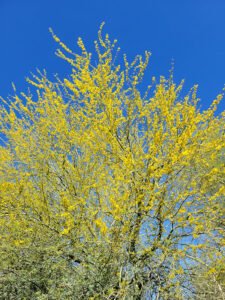
The palo brea bursts into the yellow season.
It is s-uam masad a month early. The Tohono O’odham call a particular time of the year – usually corresponding roughly to April – “the yellow season:” s-uam masad. At this time of year the palo breas and palo verdes start to break into their thunderheads of yellow blooms. Brittlebush and cassia and creosote and desert marigold – all yellow.
But here in 2026 we are headed into our first weekend in the triple digits already, and my palo brea forged ahead of schedule into its s-uam masad at the end of the first week in March.
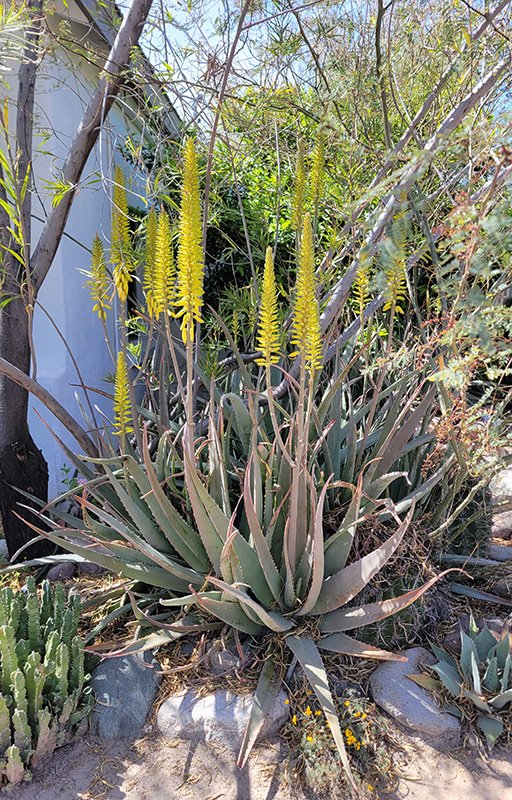
Aloe Porphyrostachys ssp koenenii v “Lodé’s Yellow”
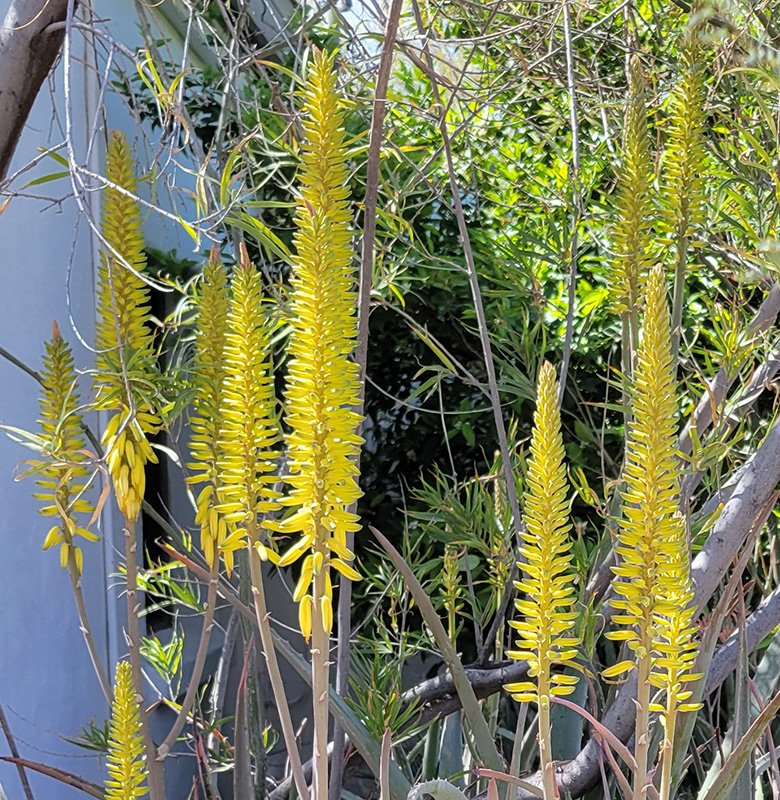
My Palestinian-Jordanian friends, Aloe porphyrostachys ssp. koenenii v. Lodé’s yellow — are a month early, too. When I moved into this house I had a few random aloes around. I am lucky to have one right outside the east-facing window I look through from my couch, and it has three tall yellow daggers blooming right now – they’re about three feet tall, perfect height to watch all the pollinators do their thing.
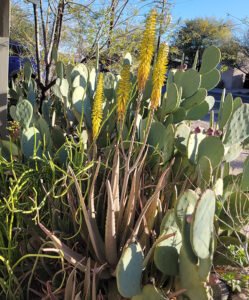
This one is more exposed than the one above, so its foliage is brownish from exposure to cold.
There were also three small ones, pretty dried up and nondescript on a tough south-facing corner of my lot. I came here in January, and it was cold – and aloes don’t really love the cold. They’re frost-hardy down into the 20s, but they turn a kind of sickly purplish-brown. The photo above was taken a month ago, when the nights were still down in the 30s, hence the brownish tone. Four years later, those three sad aloes are expanding into an aloe fence.
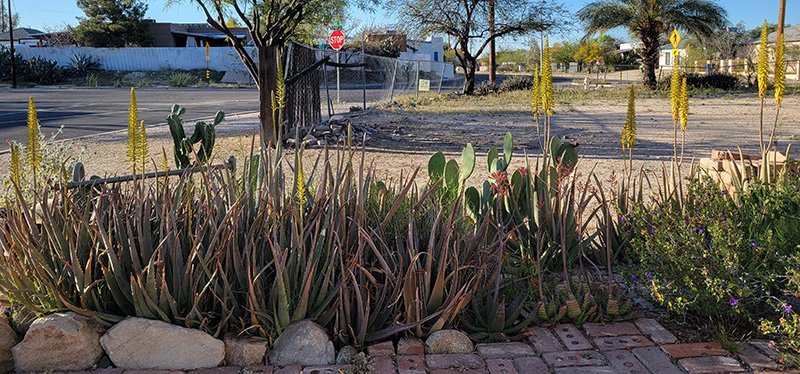
But the best thing about them by far is that they are covered with pollinators. Bees, of course; a tiny, iridescent Sonoran fly; ants. And birds! The Gila woodpecker, hummingbirds (Anna’s on mine), the tiny verdin, and – just a few days ago – a hooded oriole! The first time I’ve seen one in my garden.
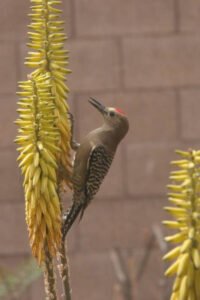
Gila woodpecker
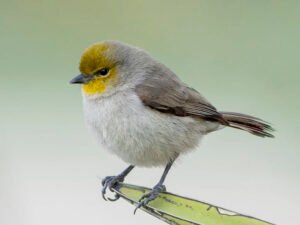
The verdin nests in acacia trees that have yellow puffball blooms exactly the size and shape of a verdin-face.
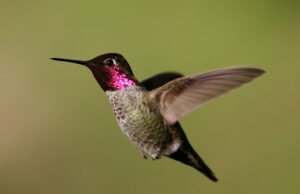
Anna’s hummingbird
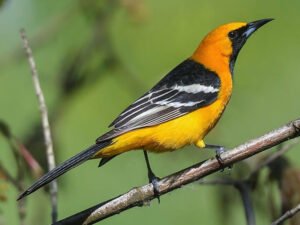
Hooded oriole (image credits at the end of the article)
In its native Palestine/Jordan, Aloe porphyrostachys ssp. koenenii is pollinated by the Palestine Sunbird. Indeed, A. porphyrostachys is all over Petra, but its blooms are yellow-orange to dark vermillion. Because Aloe vera is native further south on the Arabian peninsula, there is speculation in the journals over whether A. porphyrostachys is the one that was used, along with myrrh and spices (Lodé, Joel. CAI 111-112, p52-53), to embalm Jesus. I am so staying out of that conversation.
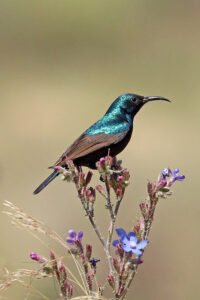
Palestine sunbird
Another lively debate argues whether or not A. porphyrostachys is just Aloe vera. Here’s just a taste of that conversation:
[San Marcos Growers] first received this plant unidentified from a plant growing in a Santa Barbara garden that had come from plantsman and CSSA journal editor Tim Harvey, who raised it from seed received as Aloe porphyrostachys ssp. koenenii from French world traveler, author and plant explorer Joel Lode. Aloe koenenii is a red to orange flowered aloe that grows naturally in rocky slopes above the ancient and historical city of Petra in southern Jordan, famous for its rock-cut architecture and water conduit system. It was first described by John Lavranos and Kerstin Koch in 2006. The specific epithet honors the German horticultural Manfred Koenen, who collected the type specimen in Jordan. Lode was also responsible for the remaining (sic – renaming?) Aloe koenenii as a variety of Aloe porphyrostachys in a 2007 edition of his journal, Cactus-Adventures International (73: 33). This name has been accepted by some and referenced in Aloe: The Definitive Guide (Royal Botanic Gardens Kew, 2011) by Susan Carter, John Lavranos, Len Newton and Colin Walker but they listed the plant in this book as Aloe koenenii. To honor Joel Lode and to note that this particular plant, which likely is a Aloe koenenii hybrid as it has yellow flowers instead of the normal carmine red to dark orange flowers of this species, we call this plant ‘Lode’s Yellow’. — https://www.smgrowers.com/products/plants/plantdisplay.asp?plant_id=4212
I followed this discussion through several articles in Cactus-Adventures International, Cactus and Succulents America, et al., and, well, I’m going to go with Kew https://powo.science.kew.org/taxon/urn:lsid:ipni.org:names:77080827-1. Seems safe.
Most of the articles that mention etymology repeat the same attribution to Ancient Greek ἀλόη (alóē), and from there to “the Arabic word al’uluh” (https://en.wikipedia.org/wiki/Aloe) or “alloue” (Malik, et al.) or “alloeh meaning ‘bitter and shiny substance,’ https://pmc.ncbi.nlm.nih.gov/articles/PMC6349368/. I hunted. No one cites the word in Arabic, and I can’t find any Arabic word – even stretching the various possible transliterations – that is related to these. So let’s consign it to ‘academic’ legend – one of those stories that everyone repeats until it gains some weird authority. (Like, in the ‘80s, the story about someone who put their wet poodle in the microwave…). This Arabic etymology is a wet poodle in a microwave. Poof!

_____
REFERENCES:
Lavranos, J. & Collenette, I.S.: “New aloes from Saudi Arabia, Part 1”. Cact. & Succ. J. (US) 72: 18-20 (2000).
Lavranos, J. & Koch, K.: “A new, yet introduced, species of Aloe from around Petra in Jordan, Cact. & Succ. J. (US) 78: 222-223 (2006).
Lodé, J.: Aventures in Jordanie, CAI No 40 (Oct 2000) (CAI = Cactus-Aventures International)
Ibid. – Aloe Porphyrostachys CAI No. 48 (Oct. 2000)
Ibid. – Aloe Porphyrostachys, suite CAI No. 49 (Jan 2001)
Lodé, Joel – CAI 111-112, p52-53
WFO (2026): Aloe koenenii Lavranos & Kerstin Koch. Published on the Internet; http://www.worldfloraonline.org/taxon/wfo-0000807628 . Accessed on: 09 Mar 2026
References re: etymology:
https://www.etymonline.com/word/aloe
https://pmc.ncbi.nlm.nih.gov/articles/PMC6349368/
https://en.wikipedia.org/wiki/Aloe
There is also a theory that the name is derived “from Hebrew אוהלים ahalim, plural of אוהל ahal,” but this seems like a stretch to me. (Curwin, David (16 March 2008). “aloe”. Balashon – Hebrew Language Detective. https://www.balashon.com/2008/03/aloe.html)
Image credits (all images are my own, except the birds):
Gila on a bloom — https://www.agaveville.org/viewtopic.php?t=7650
Verdin
© Bryan Calk, Macaulay Library
https://www.allaboutbirds.org/guide/Verdin/id
Anna’s hummingbird
By Robert McMorran, United States Fish and Wildlife Service – Anna’s hummingbird, Public Domain –
https://commons.wikimedia.org/w/index.php?curid=39739922
Hooded oriole
Jerry Ting, Macaulay Library
https://www.allaboutbirds.org/guide/Hooded_Oriole/id
Palestine sunbird
https://commons.wikimedia.org/wiki/File:Palestine_sunbird_%28Cinnyris_osea_osea%29_male_2.jpg

-
March 19, 2026
An aloe with roots in Petra
-
 November 28, 2025
Jordanian Dirt
-
 October 22, 2025
Ephedra torreyana + hogans!