
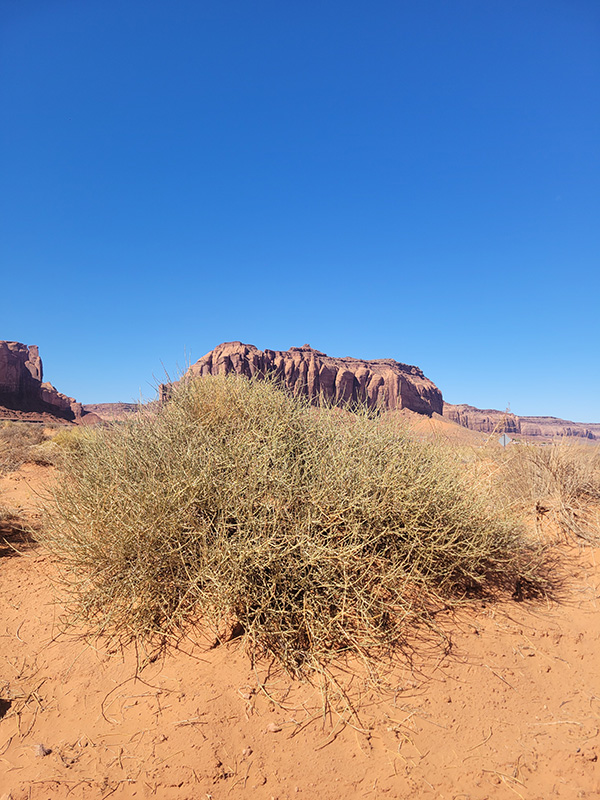
Ephedra torreyana + hogans!
In early October my mother and I went for petite road trip to northern Arizona to stay in a hogan within the Monument Valley Navajo Tribal Park. On the way up we overnighted in Holbrook (which deserves its own blog entry), and on the way back stayed in Winslow at the famous La Posada. So we spent most of three days within the Diné reservation, also known as the Navajo Nation.
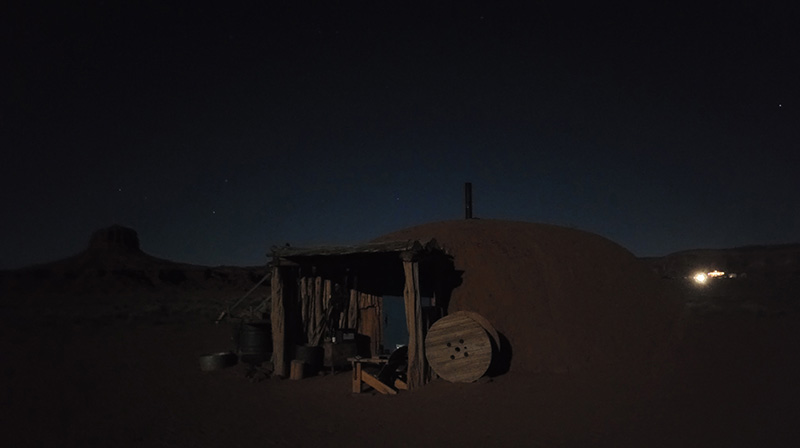
Night hogan
The hogan is owned by Ms. Verna Yazzie, and it can be reserved through her website: https://www.monetvalley.com/ For what it’s worth, hogan is pronounced HOH-ghan – (the “g” sounds like غ, if that helps, and the “n” is nasal). Her hogan is accessed by means of the Park road, but it lies just outside the Park boundary. By far the best part of the experience, for me, was the privilege of seeing the landscape without all the tourist vehicles that clog the official loop road, and to see it at my favorite times of day – dusk and dawn – empty, but so full of light and space. We were insanely lucky to be there for a full moon – oddly unplanned.
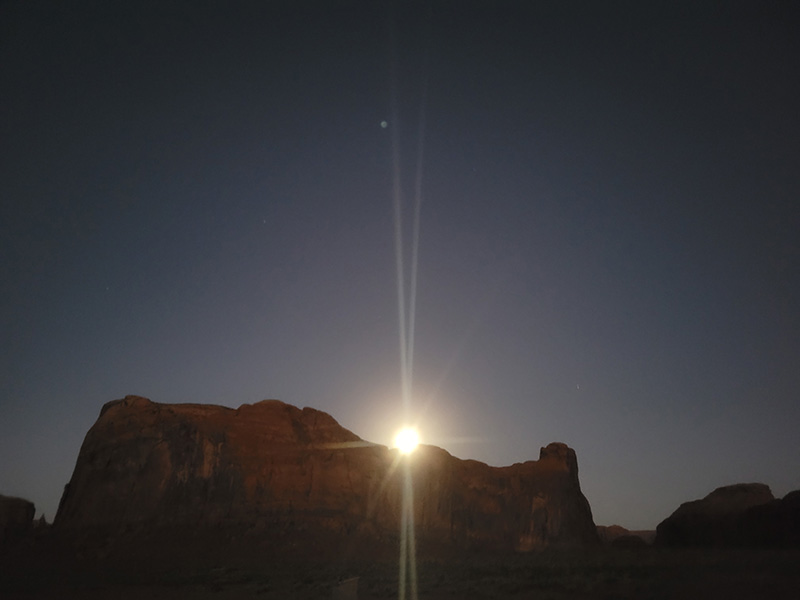
Moonrise in Monet Valley, October 6
It was hard not to start immediately seeing analogies to the deserts of southern Jordan – especially when a friend sent me an image of the same moon rising over Wadi Rum about ten hours earlier.
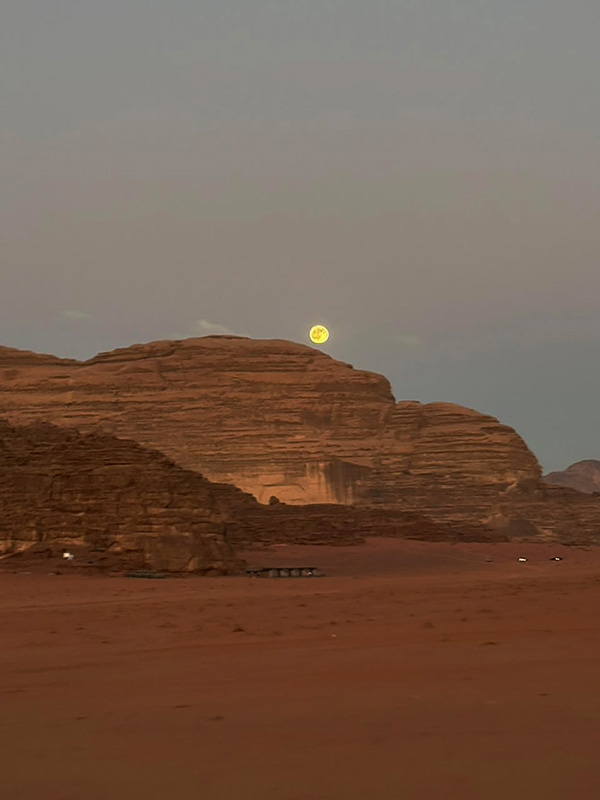
Moonrise in Wadi Rum, Jordan, Oct. 6
But there were plenty of other bells and echoes: the massive orange cliffs and formations themselves; dark green juniper and deep blue skies; sheep heading home from the spring with their attendant dogs; cave dwellings and pictographs; and I kept seeing plants and plant associations I knew from Jordan – though of course these are their New World cousins.
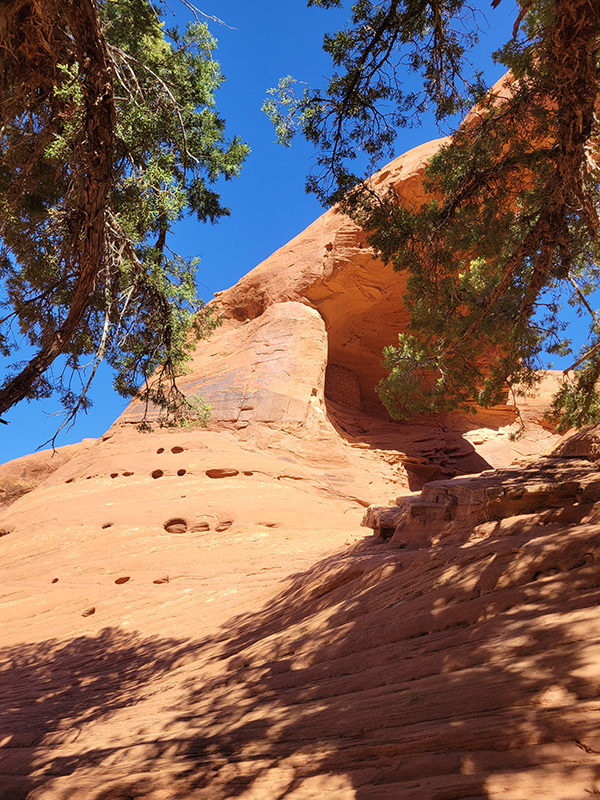
Juniperus monosperma in the next valley west (Mystery Valley).
The dominant juniper of Monument Valley is Juniperus monosperma (https://www1.usgs.gov/csas/nvcs/unitDetails/684901) instead of J. phoenicia. Their saltbush – Atriplex canescens var. angustifolia – is an important livestock forage crop for the Diné, just as Atriplex halimus is for the Jordanian bedouin. There were half a dozen other plants I thought I recognized, but couldn’t quite nail down. Then our guide showed us a plant used medicinally by the Diné, and I knew, I just knew it was an Ephedra.
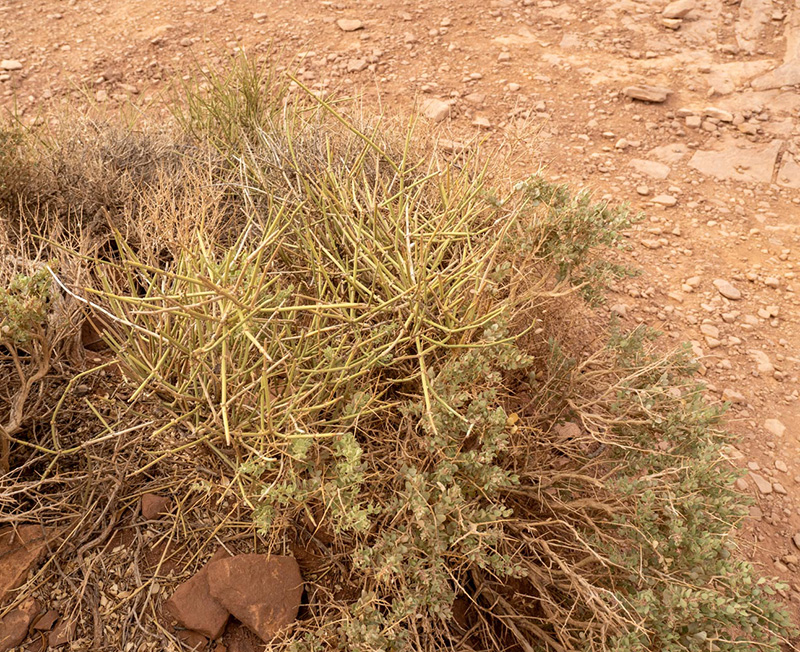
Ephedra torreyana (Mormon tea) and Atripex canescens, var. angustifolia (photo credit CJ Jones (https://conifers.org/ep/i/torreyana01.jpg)
Evidently it is most commonly known by gringo Americans as Mormon Tea. And yes – you guessed it: it’s a stimulant (think ephedrine). Mormons, who aren’t supposed to drink coffee or tea, were permitted Ephedra torreyana S Wats. as an herbal tea. But make no mistake: ephedrine comes from Ephedra, and it is a stimulant. Its Diné name is

Which sadly I am unable to pronounce.[1] According to Nanisé: A Navajo Herbal, it means ‘gray rubbing grass.’ Our guide said that the Diné, too, make a tea from it, but they roast the stems first to mellow its bitter notes. It was (is?) evidently also used as an antisyphilitic – indeed the website of the Lady Bird Johnson Wildflower Center lists Mormon Tea as Ephedra antisyphilitica, another species. Ephedra species are found all over the world, and have been for about 130 million years. They are gymnosperms – conifers. And they actually have tiny cones. Ephedra is found in my favorite desert landscapes of Jordan, too, and used — as do the Diné — as a medicine for stomach ailments.
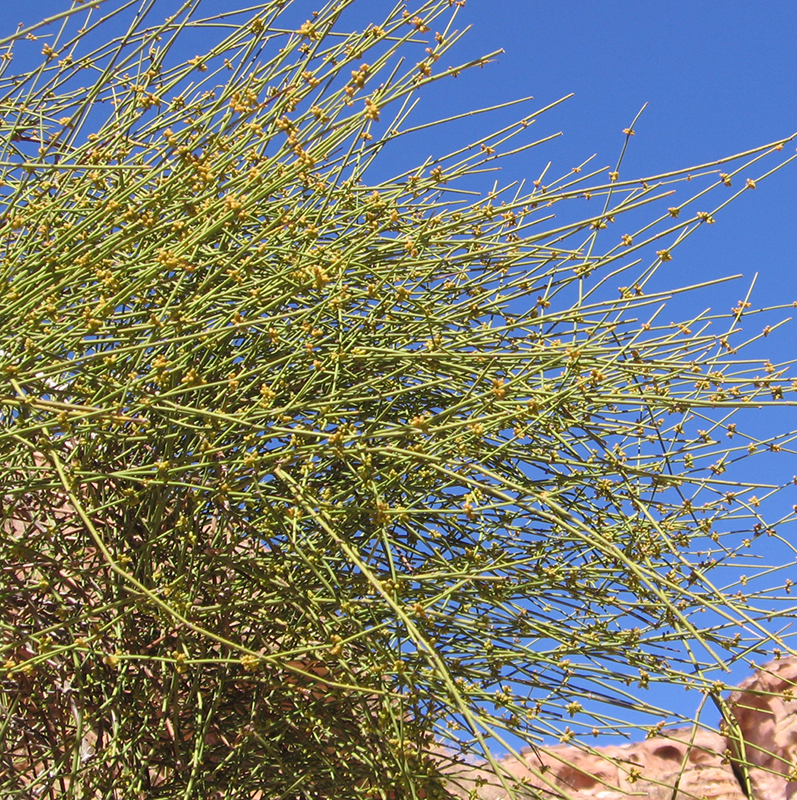
Ephedra aphylla in Petra, Jordan.
Why am I so excited about this?
Hard to say. I was just generally excited to find such strong plant parallels to a landscape that felt in so many ways familiar to me. – it was like unexpectedly running into your cousin 7,000 miles from home.
_____
More than you ever wanted to know about Ephedra…
“Ephedra” & “Ephedra torreyana.” The Gymnosperm Database. https://conifers.org/ep/Ephedraceae.php and https://conifers.org/ep/Ephedra_torreyana.php
Cutler, Hugh C. 1939. Monograph of the North American Species of the Genus Ephedra. Annals of the Missouri Botanical Garden, vol. 26 (373-428 – Torreyana at 389ff.) https://www.biodiversitylibrary.org/page/16163978#page/381/mode/1up
Elmore, Francis H. and Jeanne R. Janish. 1976. Shrubs and trees of the Southwest uplands. Tucson: Southwest Parks and Monuments Association.
Glenn, Edward P. et al. 2012. Comparison of salinity tolerance of three Atriplex spp. in well-watered and drying soils. Environmental and Experimental Botany, Volume 83, November 2012, (62-72). https://www.sciencedirect.com/science/article/abs/pii/S0098847212001062
Lacy, Barbara B. and Mayes, Vernon O. 2023. Nanisé: A Navajo Herbal: One Hundred Plants from the Navajo Reservation.
Rydin C., Pedersen KR., Crane PR., Friis EM. July 2006. “Former diversity of Ephedra (Gnetales): evidence from Early Cretaceous seeds from Portugal and North America”. Annals of Botany 98.
____
[1] I refer you to https://www.omniglot.com/writing/navajo.htm — but I have to save this for another day.
-
 November 28, 2025
Jordanian Dirt
-
October 22, 2025
Ephedra torreyana + hogans!
-
 September 19, 2025
Quailbush